Showing posts with label history. Show all posts

Sep 5, 2014

Coming Soon...

...our Italian adventures last month in Rome, Naples, Vulcano and Reggio-Calabria. Stay tuned! 


Apr 16, 2014

In the Corridors of Kings


Back in February, a long-awaited travel dream of mine was finally fulfilled. Angkor Wat was everything I thought it would be - stunning feats of artistry and architecture that speak volumes about those ancient civilizations in a way that no book can. To see up close the intricate bas-reliefs carved centuries ago, and then refurbished and re-assembled in more recent decades, is incredibly powerful. I didn't always find ruins so interesting, especially in Southeast Asia where many ancient temples all start looking the same after awhile (to the untrained eye at least!). But recently, I've been fascinated by imagining what these places tell us about our predecessors, and about ourselves.

On our last morning in Siem Reap, we took a bumpy tuk-tuk ride out to Banteay Srei. We clattered along as other tuk-tuks, cars and cyclists overtook us. We passed small villages of stilt houses with immaculately swept dirt yards and chickens strutting about. Palm oil simmered in stainless steel bowls. perched on clay stoves by the roadside. The air was perfumed with the scent of the eucalyptus trees that lined the road. It was one of those wonderful moments that remind us why we travel.

In addition to Angkor Wat, Bayon and Ta Phrom, Banteay Srei is not to be missed. Though much smaller than the others, the intricacy of the carvings is unparalleled among the temples. The pink sandstone burns beautifully as the sun rises. Despite the gaggle of tourists around taking selfies, it wasn't too difficult to imagine the sophistication and spirituality of the kingdom that built Banteay Srei back in the 10th Century.

I pondered this as a taxi whisked Pem and I back into glittering downtown Bangkok from the airport later that evening. In another thousand years, what will the monuments and structures of our era say about us? With daily news about the effects of climate change on our planet, I'm less certain our lasting legacy will be one we would claim with pride.

Some photos below from my trip, if you'd like to see... 


"Myth: we have to save the earth. Frankly, the earth doesn't need to be saved. 
Nature doesn't give a hoot if human beings are here or not. The planet has survived cataclysmic and catastrophic changes for millions upon millions of years. Over that time, it is widely believed, 99 percent of all species have come and gone while the planet has remained. Saving the environment is really about saving our environment - making it safe for ourselves, our children, and the world as we know it. If more people saw the issue as one of saving themselves, we would probably see increased motivation and commitment to do so" 
- Robert M. Lilienfeld & William L. Rathje, The Sun Magazine

Nov 11, 2013

Postcard from Chantaburi


Chantaburi seems like a sleepy little place at first, but it sure has a lot going on underneath its surface. Bordering Cambodia, this eastern province has distinctly European and Vietnamese influences in its architectural and culinary history. A centuries old gem trading hub, jewels aren't the only attraction in town. Chantaburi is also the fruitbasket of the nation, and increasingly the world*, for tropical fruits such as durian, mangosteen and sala. The soft, tangy flesh of mangosteen is too good to resist. I probably ate my weight in mangosteen in Chantaburi!

The small streets of the old town are charming and easy to walk. Down one block, you may be enticed by the overwhelming scent of freshly baked khanom khai (think smaller, rounder madeleines). Down another, you may spot some decidedly funky street art and hip little cafes. This sleepy town has its fair share of small surprises that won't fail to put a smile on your face. And well, if it doesn't, you clearly haven't been eating enough fruit!

*According to our friend Wiki, in 2000, Chantaburi alone contributed 27% of the world's durian production!


Feb 10, 2013

The City of Lanterns


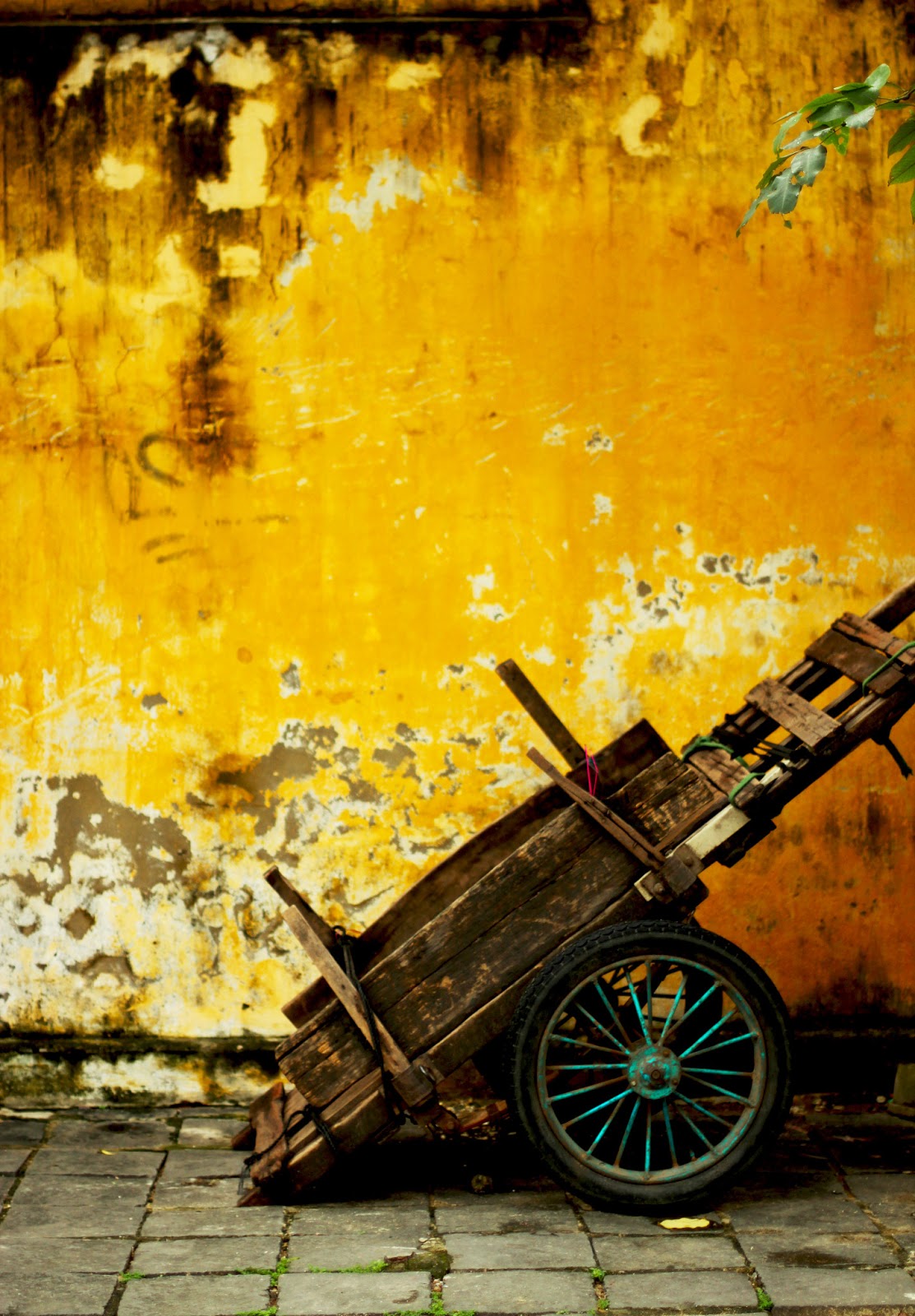
On Boxing Day, we left the imperial city of Hue to head south by taxi to Hoi An - a small, charming town that was once a bustling hub for maritime trade and thus features Chinese, Japanese, Vietnamese and European architectural and cultural influences.

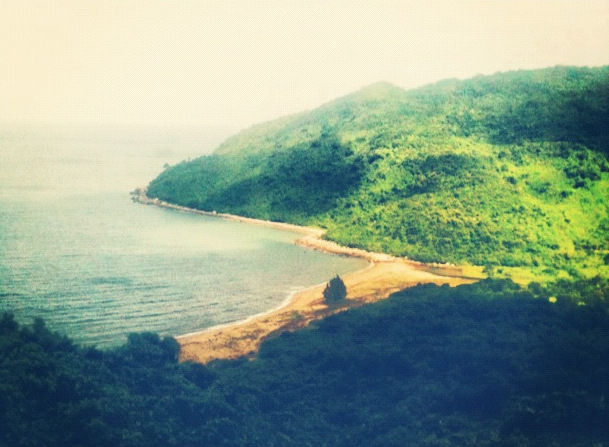
We requested our taxi driver to drive through the Hai Van pass - an opportunity to stretch our legs, buy some snacks (and pearls!) and take in the sweeping views of the East Vietnam Sea. After another stop in Danang for lunch at the chill, lounge-y Waterfront Restaurant, we continued south.

Not at all knowing what to expect, I was pleasantly surprised by the intimate feel of the town. Small winding lanes are banked by low, shuttered houses with beautiful wooden facades. Officially granted UNESCO World Heritage status in 1999, the old center of Hoi An retains a unique, and antique, charm. By night it is even more spectacular, as you explore the streets lit only by colorful lanterns hung outside every shophouse.

That night we headed out for dinner from our hotel, the sounds of Buddhist nuns chanting evening prayers while the distant beating of funeral drums added a dramatic touch to our stroll. We were wonderfully surprised to learn that our first night coincided with the full moon. Every month, Hoi An has a Full Moon Festival when the streets are completely closed to motorized vehicles. There are traditional cultural performances and the river is lined with vendors selling grilled rice cakes or candle-lit paper lanterns that you can place into the river to float your wishes and prayers to the gods. In the intimate and magical scene, you feel that at this time, in this place, the gods just might hear you.

Some photos below, with a post to follow on what we saw and where we ate (you didn't think I'd forget that did, you?).


Jan 19, 2013

The Imperial City


On Dec. 22, less than one week after traveling nearly 30 hours to move our life from D.C. to Hanoi, we returned to Hanoi's Noi Bai airport to board another flight, this time bound for Central Vietnam. A merciful 45 minutes later, our plane touched down in Danang, where we would start the scenic train journey to Hue. After a brief detour to the Danang bus station and an attempt at drawing a train station for our irate (and possibly intoxicated) taxi driver, we made it to the nha ga (from the French gare) just in time for the next Hue-bound train. The train took three times as long as the flight but the tracks hugged the coastline nearly the entire journey, so the view as we chugged along the East Vietnam Sea was simply stunning.


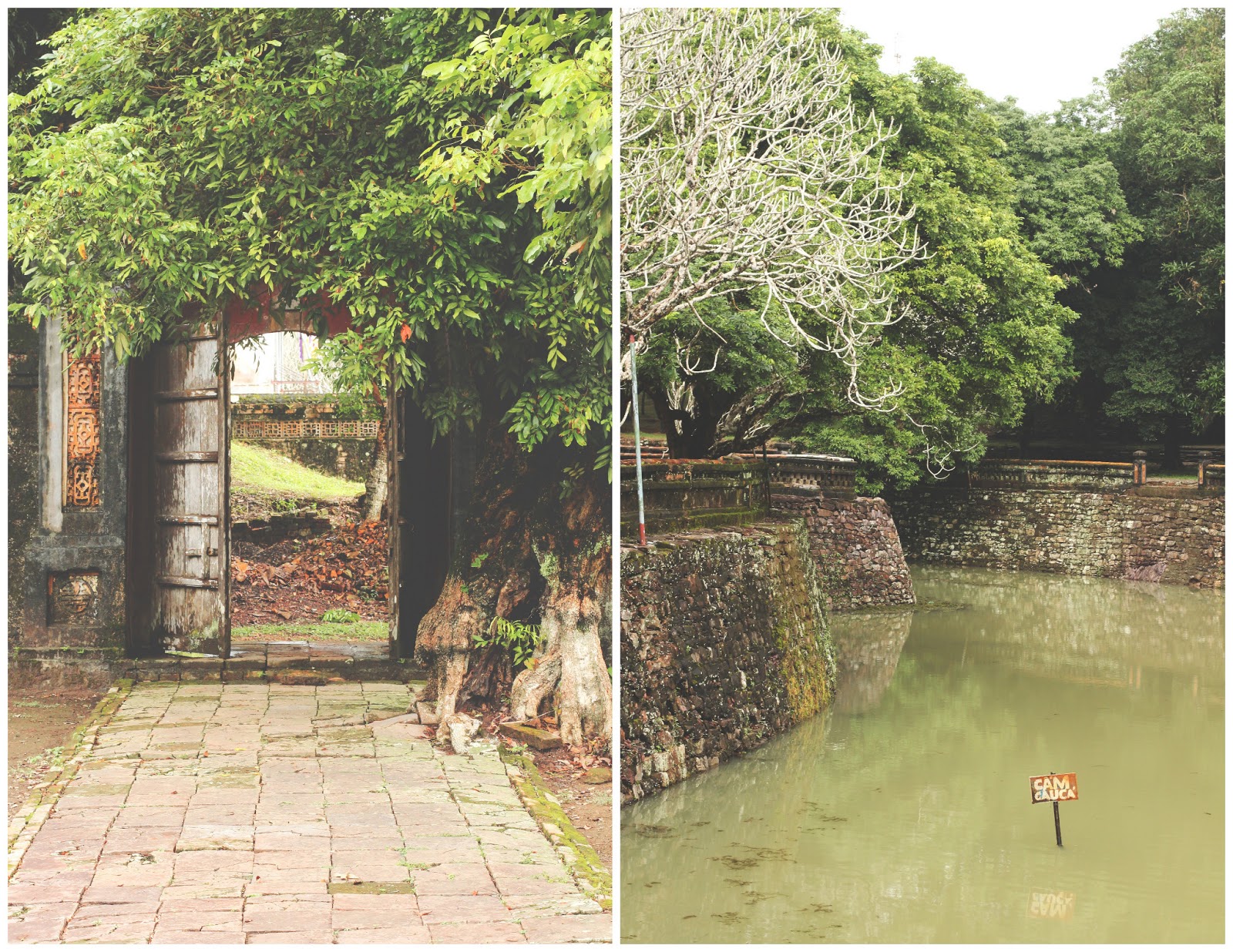
By the time we arrived, evening had begun its descent and from the taxi window, we could just make out the outlines of the citadel across the Perfume River. My parents arrived to Bangkok later that evening and over the next couple days, we made our way through the Imperial City's Forbidden Purple City in pouring rain, explored a few tombs of the Nguyen Dynasty (the last ruling Vietnamese dynasty) and visited a monastery built by Vietnamese monk Ven. Thich Nhat Hanh. Below are a few pictures of the incredible grounds of the tombs (Tu Duc, Khai Dinh, Minh Mang) as well as interesting architectural flourishes of the tomb buildings and the monastery.

Tomorrow's post will feature information about where we stayed, what we ate and more of what we saw in Hue.