Showing posts with label think photography. Show all posts

Mar 27, 2012

A Little Creative License...


Spring is officially here, which means it's time for me to come out of hibernation! It's been unusually busy for me at work lately hence the hiatus from blogging, but it definitely feels good to be back at Dolma :)

For my first post after nearly a month (!), I wanted to write about something I've been thinking a lot about lately - the value of creative license within the increasingly fact-based, news oriented production and consumption of information in our society.

The constant accessibility of 24-hr. cable news, the sheer amount of information available about nearly everyone and everything on the planet that is literally at our fingertips... it's truly awe-some and certainly makes for a more informed society but I wonder, does this make us any more intellectually curious, thoughtful and understanding of where we're positioned in relation to the things happening around us?

In some ways, certainly. Yet I sense that so much in our society now hinges upon whether something is true or not. Take the recent debate about Mike Daisey's "The Agony & Ecstasy of Steve Jobs". Despite the NPR snafu, Daisey has always presented his work as theatre. When we saw him at Woolly Mammoth last year, he was upfront about this - he said, "I am a storyteller". But now that certain details in his story have been presented as bungled or inconsistent, we're apt to think that the story he has to tell is no longer valid. Should that detract for his overarching message about how our (largely) ignorant consumerism fuels unsafe working conditions and the suffering of people halfway around the world?

When anyone tells you a story, you expect some embellishments. Storytellers want to impress upon the listener the significance of a story and elicit an emotional response to what they're sharing. If we took their story at face value, then fact-checked the hell out of it, could we be missing the point entirely of why they wanted to share their story in the first place? We're so keen on letting the facts speak for themselves, when sometimes we should probably be listening more closely to our emotional reactions instead.

I raise this because I think Daisey's work walks the same thin line that photography does. Photography can be presented as art, and photos can also be presented as fact. From photojournalism to the glossy magazine spreads of Photoshopped models to the sensationalist tabloid covers in the grocery checkout lane, the images we see daily run across the true-false spectrum. My curiosity doesn't necessarily lie in whether these images are real and true, but rather what sort of story are they telling and what meaning do we extract from them?

Oct 24, 2011

Souvenirs and Snapshots

After a passport and a ticket, the next important thing most people pack when preparing to travel is a camera.

As I ready myself for my upcoming trip to Sri Lanka, resurfacing within me are questions of the relationship between travel and taking photos. Why do we (at least I do) feel compelled to document the journey rather than simply enjoy it? Are those activities mutually exclusive? How do our photos of new destinations reflect our approach to traveling?

In On Photography, Susan Sontag writes, “The…industrialization of camera technology only carried out a promise inherent in photography from its very beginning: to democratize all experiences by translating them into images.” Though our current state of visual overload has exposed much of the world to many realities both near and far that might otherwise remain unseen, I don’t think that all experiences can be reduced to their visual components. Just like with eyes, new places and cultures are probed using our hands, our nostrils, our ears and our tongues. We form our conceptions of a place and its personality based on the story our senses, and our past, tells us. That story, I truly believe, is different for every individual soul on the planet.

Thus, I think that the circumstances in which one finds themselves composing a photograph or experiencing an emotional response to viewing a photograph is truly unique to each person. 

Take for instance, the Eiffel Tower. Once considered an eyesore (perhaps still is by some), this structure must be one of the most photographed in the world. There are certainly hundreds of similar photos of the Eiffel Tower in existence, but none are identical.


Where two photographers may want to highlight structural details...

another two may be focused on the angle... 


or the mood...
 

... and yet another two may want to capture the unmistakeable spectacle that underscores why Paris is called the City of Light.


In addition to these, some of my other favorites of La Tour Eiffel are here, here and here.

Perspectives are always different. The Eiffel Tower may be one thing, but aiming a lens at people from the countries we visit is still a bit of a gray area for me. I suppose, as always, it depends on the intent... Travel writer Pico Iyer writes, "We are objects of scrutiny as much as the people we scrutinize... and we are being consumed by the cultures we consume." I think delving into that might have to wait until another blog post...

What are your thoughts? Do you break out the camera often while on travel or do you prefer to sit back and soak in your surroundings? What do you think the purpose of taking photos while traveling is? Do you agree with Sontag's statement, below?

"...Essentially the camera makes everyone a tourist in other people's reality, and eventually in one's own"   - Susan Sontag, On Photography 


(photo credit, top to bottom: photosnocturnes, boyan photography, skantzman, patrickmayon, ianbramham,  hampshire girl, timur yalcin, the workroom)

Sep 14, 2011

More Mutatoes, Please


Check out this fabulous, funky produce! Would you buy one of these if you saw it in your neighborhood supermarket? These imperfect but beautiful fruits and veggies are the subjects of Uli Westphal's mutatoproject, which celebrates nature's oddities and diversity as our society continues to strive towards standardized, season-less produce. Though I'm sure I enjoy many genetically modified fruits and vegetables without my knowledge, I think it's so important that we seek to retain at least some of the mystery of Mother Nature's intentions.

Nothing emphasized this to me more than my recent read of Oryx and Crake, by Margaret Atwood. This is my second time reading Atwood's dystopic novel about a world driven by (and eventually destroyed by) the exaltation of bioengineering and technological innovation and it still gives me shivers.

"When any civilization is dust and ashes," he said, "art is all that's left over.  Images, words, music.  Imaginative structures.  Meaning--human meaning, that is--is defined by them." 
 - Jimmy, Oryx and Crake

Sep 10, 2011

United We Progress


"It was a test, Zeitoun thinks. Who among us could deny that we were tested? But now look at us, he says. Every person is stronger now. Every person who was forgotten by God or country is now louder, more defiant, and more determined. They existed before, and they exist again, in the city of New Orleans and the United States of America... He can only have faith that will never again be forgotten, denied, called by a name other than his own. He must trust, and he must have faith. And so he builds, because what is building, and rebuilding and rebuilding again, but an act of faith?" 

Living in D.C., there have been constant reminders that tomorrow is the 10th anniversary of 9/11. Amped up security in the Metro as well as the news constantly replaying coverage of that morning ten years ago that changed the course of America. Comparisons between Then and Now are common - photos of Ground Zero ten years ago, dusty, rubble-srewn wreckage and today, a construction site showing signs of rebirth and rebuilding.

What I'm curious to see juxtaposed before and after this decade since 9/11 is the portrayal of and attitude towards Muslims, particularly those within American society. So complex is America's relationship with its self-acclaimed status as the great melting pot, a multicultural society, I feel there are numerous instances where for every step towards a more open, understanding tie to the "Muslim World", we have seen one or even two steps backward.

What do we envisage when we think "Muslim"? Or what about "Muslim American"? "Muslim World"? Do we tend to hold certain conceptions of Muslim women and men shaped by the media? After 9/11, my South Asian male friends would half-joke that they always had to do a real clean shave before boarding any flights. Have we seen a reduction in racial, or religious, profiling? Or have we just gotten better at concealing it? I'm still mulling over these and other questions. If anything, the ten years since 9/11 has at least brought us the recognition that we will continue grappling with these questions.

"As he drives through the city during the day and dreams of it at night, his mind vaults into glorious reveries - he envisions this city and this country not just as it was, but better, far better. It can be. Yes, a dark time passed over this land, but now there is something like light. Progress is being made. It's so slow sometimes, so terribly so sometimes, but progress is being made." 
- Quotes from Zeitoun, by Dave Eggers


(photo credit: Greek-Indonesian photographer Eirini Vourloumis has captured wonderful segments of Muslim life in America - from her focus on Latino Muslims to sharing the experience of Great Muslim Adventure Day.)

Aug 18, 2011

Developing International Pornography

Oops. I meant to write "International Development Pornography". Certainly caught your eye though, no?

I don't know about you guys, but I've been receiving some interesting envelopes in the mail lately. These envelopes, usually from an organization with a mission to end child hunger, are covered in and contain images of little brown children with dirt-smudged cheeks staring out at you with imploring eyes. The envelope is encouraging- "You can help feed this child for only a nickel a day". But the weird thing is that there's an actual nickel in the envelope! If you tear open the envelope to get the nickel (and to figure out why they are sending you money) – BAM! You come face to face with an even more devastating photo of a hungry child – this time, the kid has even dirtier cheeks, possibly a cleft-lip, and his teary eyes are as wide as saucers.

By now, I've figured out how to open the envelope just enough so I can fish out the coin without seeing any of the actual contents. I've collected about $1.25 in change so far which I’ve re-distributed to some homeless people around Dupont Circle. But that’s besides my point, really.

My curiosity lies in the creation, selection and motivations of such images. Since those billions in aid dollars that were raised for the famine in Ethiopia some thirty years ago with the wide distribution of images of emaciated, naked, black toddlers, the library of so-called “international development pornography” has only grown.

How effective are these images? Have we become desensitized to them as we’ve faced increasing exposure to such pictures? And most importantly, do these images inform our concepts of worthy beneficiaries of aid?

Going beyond the targeted mailing campaigns of select US-based aid outfits, what kinds of images are associated with international development issues being discussed in mainstream media? Given the extraordinary reach of international news networks these days, it is incredible to think of how narrow and shallow most news content is.

I will never forget - three years ago, I picked up the Washington Post Sunday Edition at our neighborhood Safeway. On the front page, above the fold, was a large centered photo of a black woman in the middle of a birthing room in Sierra Leone. Even if you missed the picture, the author paints it for you in the lead paragraph.

The special edition was about maternal mortality in Sierra Leone, voted the lowest ranking on that specific development and global health indicator with one out of every 8 women dying in childbirth. Certainly something extremely important to raise people’s awareness about, but why not mention that the District of Columbia itself, the home of The Washington Post, has a shameful maternal mortality rate for being the capital of the United States? Furthermore, maternal mortality stats across the United States show that black women are three or four times more likely to die in childbirth than white women. But it's certainly easier to commentate on maternal mortality in an impoverished, poorly governed country in Africa.

No pictures for this post. I couldn't find any good ones. Don't even get me started on the Google image results you get if you search for "hungry American kid". I'll give you a hint, anyway. Google asked me, "Did you mean: angry white kid?" or "Did you mean: hungry African kid?"

Oy vey.


Jul 27, 2011

Memento Mori


I just started reading a fascinating book purchased from my beloved Kramer's Bookstore. On Photography is Susan Sontag's perspective of photography's purpose and its effect on society. First published in 1973, Sontag's analysis draws on the works of a range of photographers from Stieglitz to Arbus, Warhol to Muybridge. I'd like to share a more thorough write up with I'm done but even the introductory chapter is full of thought-provoking conclusions that I have to share. As one reviewer put it, "Not many photographs are worth a thousand of (Susan Sontag's) words." I'm not sure whether I'm in agreement with all of her words yet, but here are a few that I had to underline regardless:

"In teaching us a new visual code, photographs alter and enlarge our notions of what is worth looking at and what we have a right to observe"

"...photography is not practiced by most people as an art. It is mainly a social rite, a defense against anxiety, and a tool of power"

"All photographs are memento mori. To take a photograph is to participate in another person's (or thing's) mortality, vulnerability, mutability. Precisely by slicing out this moment and freezing it, all photographs testify to time's relentless melt."

"To take a picture is to have an interest in things as they are, in the status quo remaining unchanged (at least for as long as it takes to get a "good" picture), to be in complicity with whatever makes a subject interesting, worth photographing - including, when that is the interest, another person's pain or misfortune."

"That most logical of nineteenth-century aesthetes, Mallarme, said that everything in the world exists in order to end in a book. Today everything exists to end in a photograph."

Do you agree with any of Sontag's conclusions? What do you think the purpose of photography is?


Jul 21, 2011

Another Me

It's been tricky getting back on the blogging bandwagon after a week off, but I've been eager to share the "Another Me" project. I was first introduced to this project when conducting undergraduate research on human trafficking and sexual exploitation in Southeast Asia. After an interview with ECPAT International, I was handed a publication by the Another Me project featuring the work of documentary photographer Achinto Bhadra.

A collaboration between the Lausanne-based Terre des Hommes and Indian NGO Sanlaap, Achinto's striking portraits were of women and girls who have seen some of the darkest corners of our humanity. The part-photography/part-counseling sessions were to support these girls in "transforming their pain into power".

"Through the months of the project, the girls and women were guided by the counselor and the photographer to seek an expression of themselves... something, anything, they wanted to be... What originated as a simple photography project had become a healing experience." 

I personally love that the props and make-up used to protect the identities of his subjects further enhanced the portrayal of each girl's resiliency of spirit...


(clockwise from upper left - A Budding Branch; Durga the Powerful; A Sheltering Tree and; The Parrot)

Jul 9, 2011

Inequalities

I'm taking the GRE next Saturday which means that, among other things, I've been studying these types of inequalities....


...so I can go to grad school and study these kinds of inequalities....

China

Brazil
The United States

These photographs by James Mollison are featured in his book, "Where Children Sleep". This collection of portraits of children's bedrooms all over the world tells a sobering story about the disparate environments children grow up in. You can hear Mollison discuss the power of photographs in creating a meaningful narrative here.


Jul 3, 2011

America's Riches

The Fourth of July holiday is usually a time to be outdoors with some buddies, catching up over BBQ and beer, perhaps go tubing or catch a fireworks show. I’ll certainly be enjoying some of these things this weekend, but I’ve also been thinking about what it means to be a U.S. citizen.

The word “America” draws to mind many things – privilege, power and prosperity come to surface in my mind more prominently than others. While I’ve never been one to join patriotic rituals (not for nation, nor any school*), I do inherently believe that America is a land of freedom and opportunity.

I attended 2nd grade at an elementary school in northern Virginia. From my class, I can remember only one fellow student. Hussein was a shy, skinny kid. His family was Muslim and so every morning, he sat at his desk quietly scribbling while the 25 kids surrounding him stood up to recite the pledge of allegiance. At the time, I thought, no biggie. Now I’m awed at the integrity and bravery of this 7 yr. old boy who said, no thanks, I’ll sit this one out.

I also remember Kesha (no dollar sign), who joined our 4th grade class after his family moved to the VA suburbs from Russia. Where in Russia I don’t know – it was just an expansive, snowy place somewhere far away. He was pudgy with short, spiky hair and I remember him being incredibly polite. A lot of boys teased him for his thick Ruski accent. Then, the summer before 8th grade, Kesha hit puberty. Soon, all the girls were after him and the boys started asking him to join their pick up basketball games.

These memories are among many that have led me to always cheer diversity over division. I find the recent “coming out” of children of illegal immigrants living and working in the U.S. such an important movement, especially at this time when certain states are pushing forth regressive immigration policies. We need more Americans to understand that immigrants are not a strain on resources, they are resources - resources making America a richer and more enriching nation. To quote the wise words of Cher Horowitz, “By the end of the day, it’s like, the more the merrier… And may I remind you, it does not say R.S.V.P. on the Statue of Liberty!”

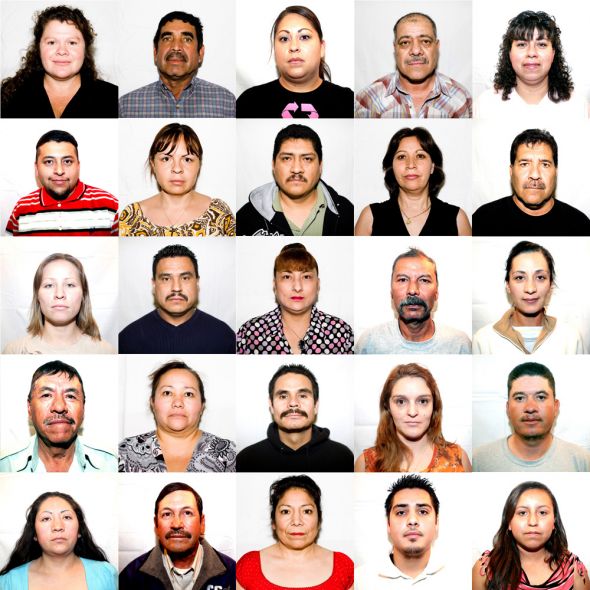
My friend Steph introduced me to the awesome photo essays of Mother Jones. The mosaic below was plucked from Matt Slaby's photo essay entitled, "Can You Spot the Future Americans?"


* that marching band stint in 9th grade was mandatory. No, really.

Jun 14, 2011

Sticks and Stones

Behind the pop culture curve, as usual, I recently caught wind of Kanye West's new music video for his song, "Monsters" via Good Magazine. 

I can't say I'm surprised at the music video's disturbing portrayal of seemingly dead women because our society continues to be fed images that glamorize violence against women. I could give the producers the benefit of the doubt and speculate that they intended to create a shocking "artistic" critique against the glamorization of violence - but I won't. From ads for Dolce & Gabbana to songs about S&M from Rihanna, these images of women being threatened, brutalized or killed are becoming trendy, normalized and even worse, portrayed as sexy.

The roots of this sociological phenomenon are intriguing, but I just wish there were a bigger trend in the opposite direction - in the production of positive images of women.

One photographer who's certainly doing his share to construct an alternative story of women is the French artist, JR. Famous for his large-scale photographs of women plastered throughout Brazilian favelas or on the train cars of Kenya's railway, his "Women Are Heroes" project celebrates women's undying generosity and strength of spirit.

Some of his installations are below. You can find out more about the "Women Are Heroes" project and documentary here and see his TEDtalk from March.


Jun 4, 2011

Nuturing Nature


Last week's issue of The Economist highlighted what geologists are starting to call the "anthropocene", a new age in the natural world's history that is human-centric. Previous geological categorizations of the world's 4 billion+ year old history put flora and fauna front and center. Humans and man-made products were peripheral to Mother Nature's movements. As we encounter climate change, developing nations' industrial growth and a human population approaching 7 billion, it's clear that our perspective of the environment has to change. 

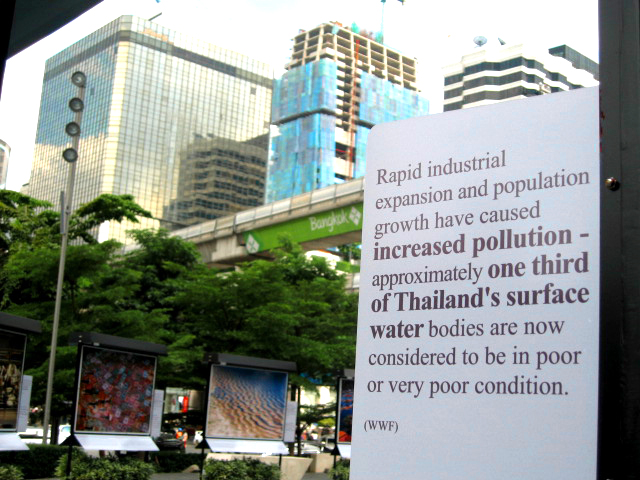
I can't think of any other photographer who so perfectly captures the beauty and gravity of this dilemma than Yann Arthus-Bertrand (four of his photos above). Specializing in aerial photography, he has used his birds-eye-view images to call attention to the endangered relationship between humans and nature. 

I was first introduced to Arthus-Bertrand's work when his Earth from Above exhibit was featured in downtown Bangkok. Accompanying his photos were quotes from the World Wildlife Fund.

Reading the Anthropocene article and re-visiting Arthus-Bertrand's portfolio reminded me of this quote, featured in The Sun magazine a couple years ago:

"Myth: we have to save the earth. 
Frankly, the earth doesn't need to be saved. 
Nature doesn't give a hoot if human beings are here or not. 
The planet has survived cataclysmic and catastrophic changes 
for millions upon millions of years. 
Over that time, it is widely believed, 99 percent of all species have come and gone 
while the planet has remained. 
Saving the environment is really about saving our environment - 
making it safe for ourselves, our children, and the world as we know it. 
If more people saw the issue as one of saving themselves, 
we would probably see increased motivation and commitment 
to actually do so" 

- Robert M. Lilienfeld & William L. Rathje